The 2026 Workflow Automation Imperative: Why Your Business Cannot Afford to Wait
Let's cut through the noise.
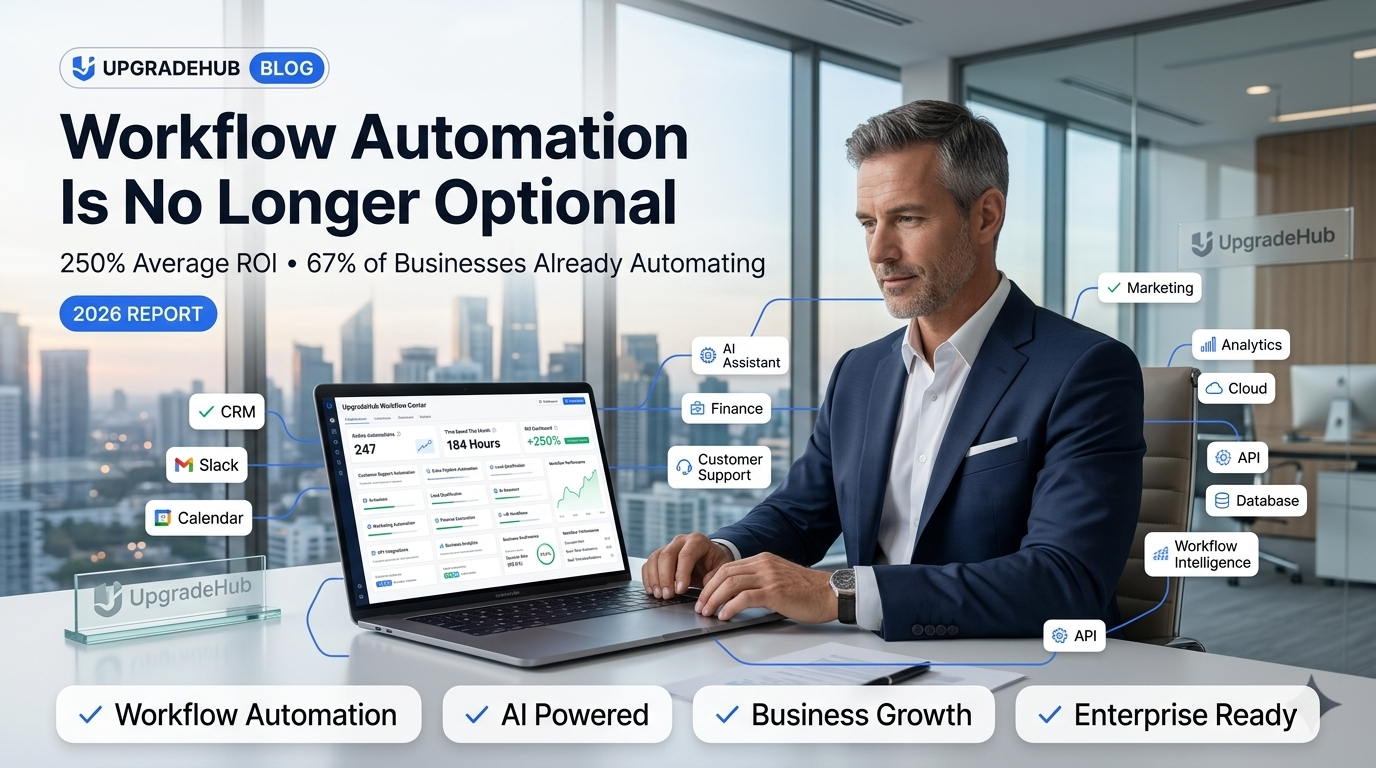
In 2026, 67% of businesses use at least one automation tool[reference:0][reference:1]. Employees using automation save an average of 3.6 hours per week on manual tasks[reference:2][reference:3]. And 89% of workers want more automation[reference:4].
Yet here's the paradox: only 12% of organizations have achieved end-to-end workflow automation[reference:5]. Most companies are still drowning in manual processes while their competitors surge ahead.
The gap between the automated and the non-automated is widening fast. And in 2026, that gap is measured in market share, profitability, and survival.
Here's everything you need to know about workflow automation in 2026—backed by the latest data, real case studies, and a practical roadmap to get started.
Part 1: The 2026 Market Reality
The Numbers That Define 2026
The workflow automation market is valued at $26.01 billion in 2026 and projected to reach $40.77 billion by 2031 at a 9.41% CAGR[reference:6][reference:7]. The business process automation (BPA) market specifically will grow from $16.32 billion in 2025 to $18.83 billion in 2026 at a 15.4% CAGR[reference:8].
But these figures only tell part of the story.
The Bigger Picture: Hyperautomation
Hyperautomation—the combination of multiple automation technologies to automate complex end-to-end processes—is forecast to surge from $76.9 billion in 2026 to $306 billion by 2035, representing a 17.4% CAGR[reference:9][reference:10].
66% of organizations have already automated at least one business function[reference:11]. 88% of organizations now regularly use AI in at least one business function[reference:12]. And 58% of employers expect robotics and automation to transform their business by 2030[reference:13].
The Adoption Gap
Despite this massive investment, 96% of companies still manage documents and workflows manually[reference:14]. 72% of organizations use six or more distinct document tools; 31% use 11 or more[reference:15].
The result? Tool sprawl is creating more complexity, not less. Organizations are drowning in disconnected systems while their teams waste hours moving data between them.
Part 2: The ROI That Changes Everything
250% Average First-Year ROI
Across all departments, workflow automation delivers an average first-year ROI of 250%[reference:16]. ROI benchmarks for workflow automation platforms range from 111% to 330%, with payback periods typically under 6 months[reference:17].
$8.76 Return for Every Dollar Invested
Companies see an average return of $8.76 for every dollar invested in automation[reference:18]. Businesses typically see a return on investment of 200–300% within the first 12 months of deploying automation solutions[reference:19].
Department-by-Department ROI
| Department | Average ROI (Year 1) | Top Use Case |
|---|---|---|
| Marketing | 300% | Email sequences, social scheduling[reference:20] |
| Operations | 275% | Workflow routing, approvals[reference:21] |
| Finance | 250% | Invoice processing, reconciliation[reference:22] |
| Sales | 200% | Lead scoring, follow-up sequences[reference:23] |
| HR | 175% | Onboarding, time-off management[reference:24] |
Source: AgileD / Salesforce[reference:25]
What This Means in Real Dollars
For a mid-sized company, automating just invoice processing can deliver $303,000 in operational cost savings[reference:26]. Organizations implementing AI workflow automation are seeing productivity increases of 25-30% and cost reductions of 10-50%[reference:27].
Nearly 40% of businesses report that automation has reduced costs by at least 25%[reference:28].
IT Automation Impact
IT teams using AI and automation cut out upwards of 30 minutes per support ticket[reference:29]. Organizations replacing large legacy ITSM platforms with modern solutions achieved an average 168% ROI over three years with a 6.1-month payback period[reference:30]. They handled 50% more tickets with roughly the same number of employees[reference:31].
Part 3: The Technology Shift—From Automation to Autonomy
Why Traditional Automation Is Breaking Down
For years, leaders invested in automation pipelines—rules engines, RPA bots, and workflow platforms—to standardize execution. Those investments delivered early gains. Today, they are approaching diminishing returns[reference:32].
The problem? Traditional automation assumes predictable inputs, relies on fixed decision logic, and expects low exception rates[reference:33]. In today's environment of constant regulatory change, fragmented technology estates, and volatile demand, exceptions have become the new norm[reference:34].
This creates three compounding problems[reference:35]:
- Automation ROI is flattening, even as spend increases
- Operational risk is rising, masked by the illusion of control
- Scale is constrained, because every new scenario requires redesign
Enter Multi-Agent Systems
The next phase of enterprise automation will be defined by multi-agent systems: distributed networks of intelligent agents that go beyond just executing tasks, operating with autonomy, coordination, and governance to deliver outcomes[reference:36].
Instead of encoding every decision upfront, organizations deploy teams of intelligent agents that collaborate toward defined business outcomes[reference:37]. In an agent-driven model[reference:38]:
- Automation can interpret context, not just data
- Decisions can be validated, challenged, and corrected in real time
- Workflows can evolve without constant re-engineering
- Risk controls can be embedded dynamically, not hardcoded
As the Communications of the ACM puts it: "Instead of continuing to ask automation to 'follow instructions,' enterprises are now asking it to reason within guardrails"[reference:39].
The Agentic AI Opportunity
The agentic AI market is valued at about $9.14 billion in 2026, with potential to expand by over 40% through 2034[reference:40]. The World Economic Forum reports the market is poised to reach $45 billion by 2030[reference:41][reference:42].
Gartner forecasts that 40% of enterprise applications will embed task-specific AI agents by the end of 2026, up from less than 5% in 2025[reference:43][reference:44][reference:45]. That's an eight-fold increase in under two years[reference:46].
74% of companies plan to deploy agentic AI within two years[reference:47]. 75% of professionals are using or experimenting with agentic automation[reference:48]. And nearly 90% of automation professionals say agentic automation has already changed their daily work[reference:49].
The $100 Billion SaaS Opportunity
Bain & Company's 2026 research reveals a $100 billion US market opportunity for Software-as-a-Service created by agentic AI's ability to automate cross-system coordination work[reference:50][reference:51]. Beyond the US, the opportunity in Canada, Europe, Australia, and New Zealand combined could double the total opportunity to about $200 billion[reference:52].
The core finding? Agentic AI's biggest opportunity isn't replacing SaaS. It's automating the expensive human coordination work that connects SaaS systems—the employees pulling data from an ERP, reconciling it against a spreadsheet, interpreting an ambiguous vendor email, and deciding whether to escalate[reference:53].
Bain finds that the highest-value automation opportunities are concentrated precisely where no single system of record owns the outcome—where decision context spans ERP, CRM, billing, and support[reference:54].
Agentic AI Reduces Costs by Up to 38%
Organizations deploying Agentic AI are seeing average operational cost reduction of up to 38%, with the largest gains in marketing operations, customer support, and back-office finance functions[reference:55][reference:56].
Companies reported[reference:57]:
- Significant increases in task throughput
- Faster execution cycles
- Fewer manual handoffs
- A sharp decline in internal bottlenecks
Part 4: Who's Getting It Right—Real-World Case Studies
Asana: $100K Annual Savings from One Workflow
Steven Borobio-Bennett, APJ Programs and Operations Lead at Asana, automated his team's revenue operations inbox using an AI Teammate[reference:58]. Results[reference:59]:
- Response times dropped from 3-4 days to under one day
- The team recovered 165.6 working hours per week by eliminating the manual intake form
- The workflow effectively recovers the equivalent of one full sales rep quota: around $100K per year
The AI Teammate automatically categorizes requests by department, effort level, and request type, pulls relevant context from past requests, and surfaces the right people for escalations[reference:60].
Atlassian: 80% Reduction in Engineering "Chores"
Atlassian used AI agents combined with Jira workflows to cut up to 80% of time on key automated repetitive tasks[reference:61].
Box: 80% Reduction in Partner Onboarding Time
Box reduced the time spent onboarding new partners from 5 hours to less than 1 hour using workflow automation[reference:62].
Workday Adaptive Planning: 242% ROI
Workday Adaptive Planning users achieved 242% ROI over 3 years with payback under 6 months[reference:63].
Paycom: 205% Annual ROI
Paycom full-solution automation delivers 205% annual ROI with[reference:64]:
- 64% overall HCM productivity gains
- 80% reduction in payroll processing time
- 63% reduction in onboarding time per hire
isaac: 50% Faster Payment Processing
After implementing an AI Agent workflow automation solution, isaac achieved a 50% reduction in payment processing time, allowing the operation to absorb demand without increasing headcount[reference:65].
Part 5: Most Automated Business Processes in 2026
| Process | Automation Adoption | Avg. Time Savings |
|---|---|---|
| Email marketing | 75% | 6 hrs/week[reference:66] |
| Social media posting | 64% | 3 hrs/week[reference:67] |
| Invoice processing | 58% | 4 hrs/week[reference:68] |
| Lead routing/CRM | 52% | 2 hrs/week[reference:69] |
| Report generation | 48% | 5 hrs/week[reference:70] |
| Customer onboarding | 38% | 3 hrs/week[reference:71] |
| Project status updates | 35% | 2 hrs/week[reference:72] |
Source: AgileD / HubSpot / Salesforce / McKinsey[reference:73]
Part 6: The Barriers—And How to Overcome Them
| Barrier | Percentage |
|---|---|
| Lack of technical knowledge | 44%[reference:74] |
| Cost concerns | 38%[reference:75] |
| Job displacement worries | 33%[reference:76] |
| Difficulty identifying processes to automate | 28%[reference:77] |
| Integration complexity | 22%[reference:78] |
Source: AgileD[reference:79]
The reality:
- Most automation tools have free tiers or affordable entry-level plans
- Low-code/no-code platforms (Zapier, Make, Microsoft Power Automate) let you build workflows without coding
- Start small—automate one process, measure the results, then scale
Part 7: Where Automation Doesn't Work
Not everything should be automated[reference:80]:
- Processes requiring judgment: Complex decisions, nuanced client communication, creative strategy
- Rarely-executed tasks: If you do something once a year, it's probably not worth automating
The key is knowing the difference.
Part 8: Your 4-Step Automation Roadmap
Step 1: Audit Your Workflows
Track where your team spends time. Look for:
- Repetitive tasks done daily or weekly
- Tasks that involve moving data between systems
- Approval processes stuck in email chains
- Reports generated manually
Step 2: Prioritize
Use the 80/20 rule: 80% of your ROI will come from 20% of your automated processes. Start with high-volume, rule-clear processes: invoice approvals, employee onboarding, vendor management.
Your first workflow should be:
- Something you do at least 3x per week
- Rule-based (no judgment calls)
- Low complexity (2-3 steps max)
Step 3: Choose the Right Tool
| Tool | Best For | Starting Price |
|---|---|---|
| Zapier | App-to-app automation | Free |
| Make | Visual automation | Free |
| Microsoft Power Automate | Microsoft ecosystem | Free |
| n8n | Open-source automation | Free |
| Kissflow | Enterprise workflow management | Quote-based[reference:81] |
Step 4: Measure and Scale
Set clear metrics before implementing:
- Time saved per week
- Error reduction
- Cost savings
- Employee satisfaction
If you're not seeing measurable results in 3 months, try a different tool or process.
Part 9: The Bottom Line
Workflow automation in 2026 isn't a nice-to-have—it's a competitive necessity.
- 67% of your competitors are already automating
- 250% average first-year ROI is waiting
- 3.6 hours per week per employee can be reclaimed
- Up to 38% cost reduction is achievable[reference:82]
- Under 6 months average payback period
The window for competitive advantage is shrinking fast[reference:83].
The technology is ready. The ROI is proven. The question isn't whether you should automate.
It's whether you can afford not to.
FAQ: Workflow Automation for Business Owners
How much does workflow automation cost? Most tools have free tiers. Paid plans start at $20-50/month. Enterprise solutions cost more but deliver higher ROI.
Can I automate without technical skills? Yes. Low-code/no-code platforms let you build workflows without coding[reference:84].
What's the easiest thing to automate first? Data entry between apps, meeting scheduling, or email responses. These are simple, high-impact, and easy to set up.
How do I measure automation success? Track time saved, error reduction, and employee satisfaction. Most automation delivers 10-15x ROI.
How long does it take to see results? Most businesses see measurable results within 3 months. Some see immediate improvements in cycle times.
Is my business ready for AI automation? Start with data standardization and high-volume, rule-based processes. Build your foundation before layering on AI.
What's Next? Key 2026 Predictions
- Autonomous AI agents will execute end-to-end workflows across organizations[reference:85]
- Multi-agent systems will replace rigid automation pipelines[reference:86]
- 40% of enterprise applications will embed task-specific AI agents[reference:87]
- Hyperautomation will surge from $76.9B to $306B by 2035[reference:88]
- Agentic AI will reduce operational costs by up to 38%[reference:89]
Sources: ACM Communications, AgileD, Asana, Atlassian, Bain & Company, Deloitte, Forbes, Gartner, Kissflow, McKinsey, Mordor Intelligence, Research and Markets, Salesforce, UiPath, Workday, World Economic Forum, Zapier. All data reflects 2026 market conditions as of July 2026.