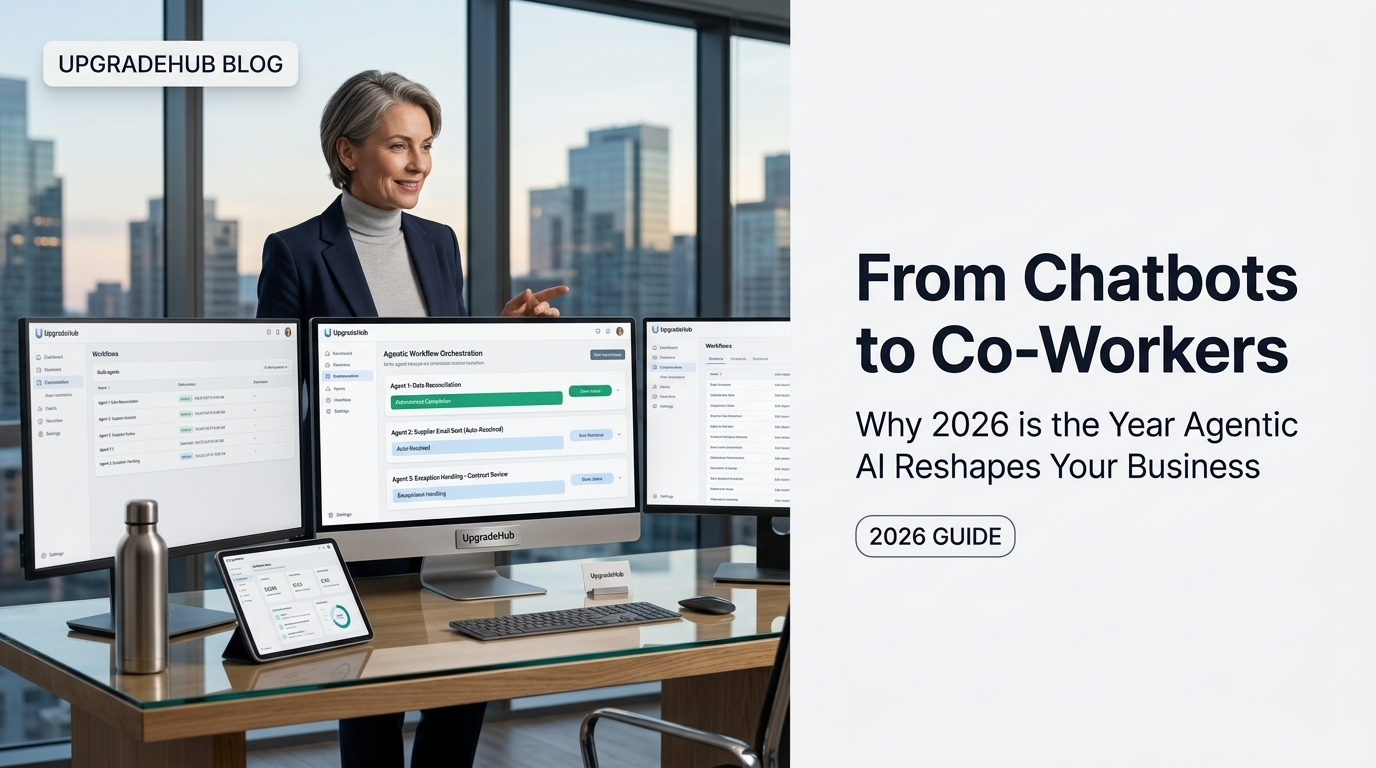
From Chatbots to Co-Workers: Why 2026 is the Year Agentic AI Reshapes Your Business
If 2025 was the year of the chatbot, 2026 is the year of the autonomous agent.
The conversation has shifted. Business leaders are no longer asking whether AI belongs in their automation strategy—that debate is effectively over[reference:0]. Instead, they're asking harder questions: Can automation adapt when reality doesn't follow the plan? Can leaders rely on it when pressure is highest? Does it genuinely make the business stronger, not just faster?[reference:1]
Here's what the data shows: 67% of businesses now use at least one automation tool, and employees using automation save an average of 3.6 hours per week on manual tasks[reference:2]. But the bigger story in 2026 isn't about saving a few hours—it's about fundamentally redesigning how work gets done.
Welcome to the era of agentic AI.
The Big Shift: From Chatbots to Autonomous Agents
If the AI buzz of 2025 was about chatbots, 2026 is about autonomous agents[reference:3]. Agentic AI is moving beyond tools that assist people and toward systems that can run entire workflows end-to-end[reference:4].
This isn't just hype. According to Gartner, 40% of enterprise applications now embed task-specific AI agents, up from less than 5% in 2024—an eight-fold increase in under two years[reference:5][reference:6]. The agentic AI market is valued at about $9.14 billion in 2026, with a potential to expand by over 40% through 2034[reference:7]. The World Economic Forum reports the market is poised to reach $45 billion by 2030[reference:8].
The fundamental difference? Traditional automation follows instructions. Agentic AI reasons within guardrails[reference:9].
As the Communications of the ACM puts it: "Instead of continuing to ask automation to 'follow instructions,' enterprises are now asking it to reason within guardrails"[reference:10]. This means AI that can interpret context, validate decisions in real time, and evolve workflows without constant re-engineering[reference:11].
Why Traditional Automation is Breaking Down
For years, leaders invested in automation pipelines—rules engines, RPA bots, and workflow platforms—to standardize execution and reduce manual effort[reference:12]. Those investments delivered early gains. Today, they are approaching diminishing returns[reference:13].
The problem? Traditional automation assumes predictable inputs, relies on fixed decision logic, and expects low exception rates[reference:14]. But today's operating environment is defined by constant regulatory change, fragmented technology estates, unstructured data, and volatile demand[reference:15].
In this environment, exceptions have become the new norm[reference:16]. Most automation programs now spend more time managing exceptions than delivering net efficiency[reference:17].
This creates three compounding problems:
- Automation ROI is flattening, even as spend increases
- Operational risk is rising, masked by the illusion of control
- Scale is constrained, because every new scenario requires redesign[reference:18]
Multi-agent systems represent a fundamental change. Instead of encoding every decision upfront, organizations deploy teams of intelligent agents that collaborate toward defined business outcomes[reference:19].
The Market Reality: Numbers That Matter
Digital Transformation Market
- 2025: $2.1 trillion
- 2026: $2.54 trillion (20.8% CAGR)
- 2031 forecast: $5.33 trillion[reference:20][reference:21]
Business Process Automation Market
- 2025: $13.06 billion
- 2026: $14.96 billion (14.5% CAGR)[reference:22]
Workflow Automation & Optimization Software
- 2025: $5.99 billion
- 2026: $6.61 billion (10.44% CAGR)
- 2032 forecast: $12.01 billion[reference:23]
Agentic AI Market
- 2026: ~$9.14 billion
- 2030 forecast: $45 billion[reference:24][reference:25]
Adoption Statistics
- 67% of businesses use at least one automation tool[reference:26]
- 60% of occupations have at least 30% of activities that could be automated[reference:27]
- 88% of organizations now operate hybrid IT environments[reference:28]
- 58% of employers expect robotics and automation to transform their business by 2030[reference:29]
- Nearly 40% say automation has reduced costs by at least 25%[reference:30]
Agentic AI: The $100 Billion Opportunity
Bain & Company's 2026 research reveals a $100 billion US market opportunity for SaaS created by agentic AI's ability to automate cross-system coordination work[reference:31]. Beyond the US, the opportunity in Canada, Europe, Australia, and New Zealand combined could double the total opportunity to about $200 billion[reference:32].
The core finding? Agentic AI's biggest opportunity isn't replacing SaaS. It's automating the expensive human coordination work that connects SaaS systems[reference:33].
Think about it: the employees pulling data from an ERP, reconciling it against a spreadsheet, interpreting an ambiguous vendor email, and deciding whether to escalate. That labor has been untouchable by traditional automation—and agentic AI changes the equation[reference:34].
Bain finds that the highest-value automation opportunities are concentrated precisely where no single system of record owns the outcome—where decision context spans ERP, CRM, billing, and support[reference:35].
Automatable Workflow Tasks by Function
| Function | Automatable Tasks |
|---|---|
| Customer Support & R&D/Engineering | 40-60% |
| Finance & HR | 35-45% |
| Sales & IT | 30-40% |
| Legal (Contract Review & Compliance) | 20-30% |
Finance has pockets of very high automation (accounts payable, payroll) alongside judgment-heavy work (financial planning). Legal offers an interesting contrast: contract review and compliance workflows are highly repeatable, but the consequences of errors are severe[reference:36].
The ROI Reality: What Automation Actually Delivers
| Automation Type | Average First-Year ROI | Top Use Case |
|---|---|---|
| Marketing | 300% | Email sequences, social scheduling |
| Operations | 275% | Workflow routing, approvals |
| Finance | 250% | Invoice processing, reconciliation |
| Sales | 200% | Lead scoring, follow-up sequences |
| HR | 175% | Onboarding, time-off management |
Overall average: 250% ROI in the first year[reference:37][reference:38][reference:39]
Most automation deployments deliver payback in under 6 months[reference:40].
Agentic AI delivers even more dramatic results. Organizations saw an average operational cost reduction of up to 38%, with the largest gains occurring in marketing operations, customer support, and back-office finance functions[reference:41].
The Technology Trends Reshaping 2026
1. ERPs Become "Systems of Action"
For decades, enterprise resource planning platforms have been treated primarily as systems of record. That's changing. In 2026, as AI adoption expands and agentic systems move beyond chat and analysis into execution, the ERP's value will increasingly come from how effectively it drives action[reference:42].
Service Orchestration and Automation Platforms play a pivotal role, connecting ERP data models to move from insight to execution with greater reliability[reference:43].
2. AI Governance Moves from Policy to Operating Model
Most enterprises now have some form of AI governance framework, but few have fully operationalized it. That will change quickly in 2026. Effective AI governance will look much more like an operating model—clearly defined boundaries for autonomous action, explicit escalation paths for human oversight, and transparent validation[reference:44].
Strong governance is an enabler rather than a constraint. Teams move faster when they trust the systems they rely on[reference:45].
3. Shadow AI Forces Orchestration to the Forefront
As AI capabilities expand, enterprises face a familiar challenge in a new form: shadow AI. Just as shadow IT emerged during the early days of cloud adoption, unauthorized AI usage is now forcing organizations to rethink their orchestration strategies[reference:46].
4. Small Language Models Replace One-Size-Fits-All AI
In 2026, small language models (SLMs) are replacing massive general-purpose models with focused, cost-efficient alternatives[reference:47]. As Andy Markus, AT&T's chief data officer, told TechCrunch: "Fine-tuned SLMs will be the big trend and become a staple used by mature AI enterprises in 2026, as the cost and performance advantages will drive usage over out-of-the-box LLMs"[reference:48].
5. Multi-Agent Systems: The Next Frontier
The next phase of enterprise automation will be defined by multi-agent systems: distributed networks of intelligent agents that go beyond just executing tasks, operating with autonomy, coordination, and governance to deliver outcomes[reference:49].
This is what experts call a "strategic reset"[reference:50].
Real-World Examples: Who's Doing It Right
Walmart
AI agents help handle payroll and paid time off, support merchandising teams, and make it easier for customers to find the right products[reference:51].
AstraZeneca
Agentic AI acts as a research assistant, automating repetitive tasks, making sense of massive datasets, and helping scientists move faster from insight to discovery[reference:52].
Early Adopters Across Industries
Strong potential spans supply chain coordination, research and development workflows, knowledge management, and cybersecurity[reference:53]. 74% of companies plan to deploy agentic AI within two years[reference:54].
The Barriers and How to Overcome Them
| Barrier | Percentage |
|---|---|
| Lack of technical knowledge | 44% |
| Cost concerns | 38% |
| Job displacement worries | 33% |
| Difficulty identifying processes to automate | 28% |
| Integration complexity | 22% |
The reality: Most automation tools have free tiers, and low-code/no-code platforms (Zapier, Make, Microsoft Power Automate) let you build workflows without coding[reference:55].
Where Automation Doesn't Work (Yet)
Not everything should be automated. Processes requiring complex judgment, nuanced client communication, creative strategy, or rarely-executed tasks are typically poor candidates for automation[reference:56].
The key is knowing the difference.
What This Means for Your Business
If you're a business owner or operations leader in 2026:
-
Stop experimenting. Start executing. The focus has moved from endless pilots to real business value[reference:57].
-
Redesign workflows around AI agents, don't just bolt them onto existing processes[reference:58].
-
Start with high-value, cross-system workflows—the ones that currently require humans to coordinate between different tools.
-
Build governance into your automation foundation, not just in policy documents[reference:59].
-
Embrace agentic AI, don't fear it. The companies that figure this out first will capture the $100 billion opportunity[reference:60].
The Bottom Line
2026 is the year business automation grows up. The question is no longer whether to automate, but how intelligently, how broadly, and how fast.
The technology is ready. The ROI is proven. The market is moving.
The only question left: Are you?
Sources: ACM Communications, Bain & Company, Deloitte, Entrepreneur, Gartner, McKinsey, Redwood Software, Research and Markets, Salesforce, TechCrunch, UiPath, World Economic Forum, Zapier. All data reflects 2026 market conditions as of July 2026.